


Page 47 - MMTTP_Guidelines_English
P. 47
Implementation Framework for Capacity Building Workshop on Science Communication


           A host institute can exercise autonomy in assigning facilitators, setting syllabi, and developing
           pedagogical approaches in accordance with the following standardised Programme modalities:
           a.  Participants  –  Young  Faculty  Members  from  NITs,  particularly  from  any
           science/engineering department.


           b. Eligibility for Nomination / Selection –Regular faculty with 3 year experience.

           c. Batch size – Up to 40 participants, with a preference for gender diversity (1 male and 1 female
           from each institution).

           d. No. of Programmes – Minimum 2 in a year

           e. Mode of delivery & duration – 5 Days (residential)

           f. Modules – Host institutions will have full autonomy to design curriculum and pedagogy of
           the Programme

           g. Assessment and certificate of participation – The host institution shall assess the learning
           outcomes of the participants. Upon successful completion of the Programme, Host Institution
           shall award a certificate of completion under the aegis of Malaviya Mission Teacher Training
           Programme (MMTTP). Assessment is primarily to see effectiveness of the delivery and feedback
           to the participants.

           h.  Feedback  Mechanism  -  Participants  are  required  to  fill  in  the  feedback  form  after  each
           Programme.

           Financial Norms

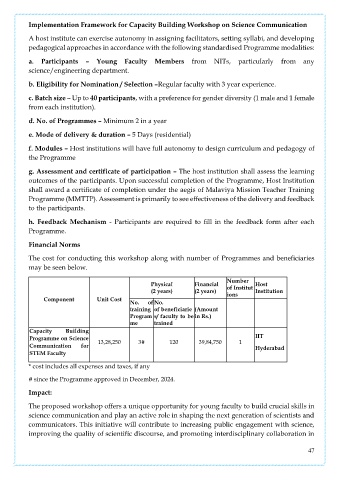
           The cost for conducting this workshop along with number of Programmes and beneficiaries
           may be seen below.

                                                                                 Number
                                                      Physical       Financial   of Institut  Host
                                                      (2 years)      (2 years)   ions      Institution
                Component          Unit Cost
                                               No.   of No.
                                               training  of beneficiarie (Amount
                                               Program s/ faculty to be in Rs.)
                                               me      trained
           Capacity     Building
           Programme on Science                                                            IIT
           Communication      for   13,28,250     3#         120       39,84,750     1     Hyderabad
           STEM Faculty

           * cost includes all expenses and taxes, if any
           # since the Programme approved in December, 2024.

           Impact:

           The proposed workshop offers a unique opportunity for young faculty to build crucial skills in
           science communication and play an active role in shaping the next generation of scientists and
           communicators. This initiative will contribute to increasing public engagement with science,
           improving the quality of scientific discourse, and promoting interdisciplinary collaboration in


                                                                                                             47

