


Page 33 - EVALUATION ENGLISH
P. 33
Evaluation Reforms

                   3.  Assessment Rubrics


                   3.1  Introduction
                   A rubric for assessment, also called a scoring guide, is a tool used to interpret and grade students’
                   on any kind of work against criteria and standards.

                   An  assessment  rubric  provides  the  means  to  increase  objectivity  in  assessment  and  reduce
                   subjectivity; presents a clear expectation on the assessments, and relates it to learning outcomes;
                   ensures consistency, transparency and fairness in the marking process across course instructors
                   for the same assessment type; efficiently grades or marks many assessments for a large group of
                   students; defines clear guidelines for moderation; and provides more objective data for analytics.

                   3.2  Structure of  a Rubric

                   Usually in the form of a grid, a grading/ marking/ scoring rubric combines the elements of
                   performance, criteria and descriptors to create an assessment tool for the course instructor


                                                           Rubric title
                                Criteria                       Level of Performance
                                                    Scrore 1         Score 2          Score 3
                                Criterion 1
                                Criterion 2                        Descriptiors
                                Criterion 3

                   The assessment criteria define the characteristics or traits to be judged which should be derived
                   from the course learning outcomes and indicate what is expected to be demonstrated.
                   Level of  performance is the rating or measure on the degree of achievement on a particular
                   criterion as specified by the rubric, i.e. excellent/good/satisfactory/poor etc.
                   Descriptors  identify  the  qualities  required  to  demonstrate  achievement  of  each  level  of
                   performance for each criterion. Listed in the form of short explanations, they provide guidance
                   on the actual judgement on the assessment to match students’ performance.
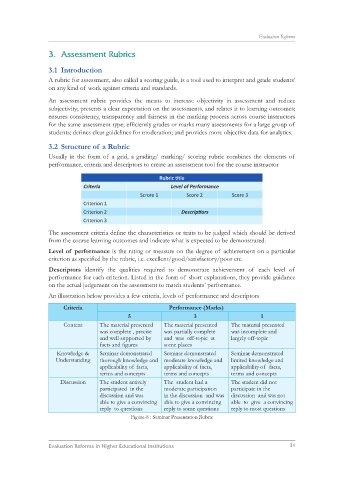
                   An illustration below provides a few criteria, levels of performance and descriptors

                        Criteria                               Performance (Marks)
                                                5                       3                       1
                        Content      The material presented   The material presented  The material presented
                                     was complete , precise   was partially complete  was incomplete and
                                     and well supported by   and  was  off-topic  at  largely off-topic
                                     facts and figures       some places
                      Knowledge &    Seminar demonstrated    Seminar demonstrated     Seminar demonstrated
                     Understanding   thorough knowledge and moderate knowledge and   limited knowledge and
                                     applicability of facts,   applicability of facts,  applicability of  facts,
                                     terms and concepts      terms and concepts       terms and concepts
                       Discussion    The student actively    The  student had a       The student did not
                                     participated  in the    moderate participation   participate in the
                                     discussion and was      in the discussion  and was  discussion  and was not
                                     able to give a convincing  able to give a convincing    able  to  give  a convincing
                                     reply  to questions     reply to some questions  reply to most questions
                                                 Figure-8 : Seminar Presentation Rubric


                   Evaluation Reforms in Higher Educational Institutions                                   31

