


Page 32 - EVALUATION ENGLISH
P. 32
Evaluation Reforms

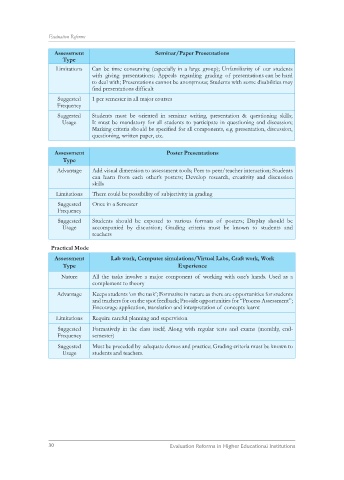
                     Assessment                           Seminar/Paper Presentations
                        Type
                      Limitations  Can be time consuming (especially in a large group); Unfamiliarity of our students
                                   with  giving  presentations;  Appeals  regarding  grading  of presentations can be hard
                                   to deal with; Presentations cannot be anonymous; Students with some disabilities may
                                   find presentations difficult

                      Suggested    1 per semester in all major courses
                      Frequency
                      Suggested    Students  must  be  oriented  in  seminar  writing,  presentation  &  questioning  skills;
                        Usage      It must be mandatory for all students to participate in questioning and discussion;
                                   Marking criteria should be specified for all components, e.g. presentation, discussion,
                                   questioning, written paper, etc.


                     Assessment                               Poster Presentations
                        Type
                      Advantage    Add visual dimension to assessment tools; Peer to peer/teacher interaction; Students
                                   can  learn  from  each  other’s  posters;  Develop  research,  creativity  and  discussion
                                   skills
                      Limitations  There could be possibility of subjectivity in grading

                      Suggested    Once in a Semester
                      Frequency
                      Suggested    Students  should  be  exposed  to  various  formats  of  posters;  Display  should  be
                        Usage      accompanied  by  discussion;  Grading  criteria  must  be  known  to  students  and
                                   teachers


                    Practical Mode
                     Assessment           Lab work, Computer simulations/Virtual Labs, Craft work, Work
                        Type                                      Experience
                       Nature      All  the  tasks  involve  a  major  component  of  working  with  one’s  hands.  Used  as  a
                                   complement to theory
                      Advantage    Keeps students ‘on the task’; Formative in nature as there are opportunities for students
                                   and teachers for on the spot feedback; Provide opportunities for “Process Assessment”;
                                   Encourage application, translation and interpretation of concepts learnt

                      Limitations  Require careful planning and supervision
                      Suggested    Formatively  in  the  class  itself;  Along  with  regular  tests  and  exams  (monthly,  end-
                      Frequency    semester)
                      Suggested    Must be preceded by  adequate demos and practice; Grading criteria must be known to
                        Usage      students and teachers.


                   30                                          Evaluation Reforms in Higher Educational Institutions

