


Page 17 - UNNAT BHARAT ABHIYAN
P. 17
16                  Fostering Social Responsibility & Community Engagement in Higher Education Institutions in India


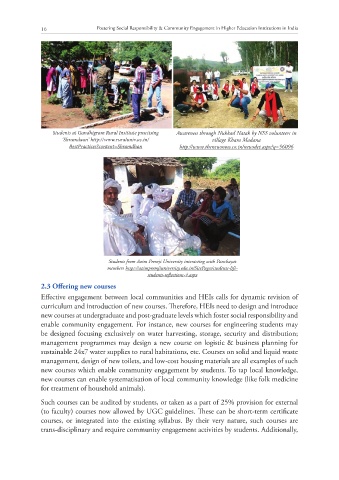
                    Students at Gandhigram Rural Institute practising   Awareness through Nukkad Natak by NSS volunteers in
                       ‘Shramdaan’ http://www.ruraluniv.ac.in/              village Khara Madana
                         BestPractices?content=Shramdhan        http://www.thenewsnow.co.in/newsdet.aspx?q=56096


                                       Students from Azim Premji University interacting with Panchayat
                                       members https://azimpremjiuniversity.edu.in/SitePages/students-life-
                                                     students-reflections-4.aspx
               2.3 Offering new courses
               Effective engagement between local communities and HEIs calls for dynamic revision of
               curriculum and introduction of new courses. Therefore, HEIs need to design and introduce
               new courses at undergraduate and post-graduate levels which foster social responsibility and
               enable community engagement. For instance, new courses for engineering students may
               be designed focusing exclusively on water harvesting, storage, security and distribution;
               management programmes may design a new course on logistic & business planning for
               sustainable 24x7 water supplies to rural habitations, etc. Courses on solid and liquid waste
               management, design of new toilets, and low-cost housing materials are all examples of such
               new courses which enable community engagement by students. To tap local knowledge,
               new courses can enable systematisation of local community knowledge (like folk medicine
               for treatment of household animals).

               Such courses can be audited by students, or taken as a part of 25% provision for external
               (to faculty) courses now allowed by UGC guidelines. These can be short-term certificate
               courses,  or  integrated  into  the  existing  syllabus.  By  their  very  nature,  such  courses  are
               trans-disciplinary and require community engagement activities by students. Additionally,

