


Page 16 - UNNAT BHARAT ABHIYAN
P. 16
Fostering Social Responsibility & Community Engagement in Higher Education Institutions in India  15


               the classroom and laboratories. Therefore, new approaches to learning based on dialogical,
               co-learning, participatory and problem- oriented methods are required for teaching existing
               curriculum.  If a part of the theory is complemented with field-based application, the
               value and usability of the theory increases manifold. This will improve quality of learning
               through application of classroom theory in the field realities. It will also contribute to
               deeper sensitisation of students and faculty to the socio-economic realities of our nation.
               The wisdom, knowledge and expertise of local communities and practitioners will also thus
               become accessible to students and their teachers alike.

               BPS  University  (www.bpswomenuniversity.ac.in)  in  Haryana  adapted  their  teaching
               methods to promote community engagement of students. From such an engagement,
               students  developed  field  projects  on  rural  energy,  self-employment,  and  women’s
               livelihood. Teaching methods included practice of knowledge gained in classroom with
               local women’s groups and panchayats.

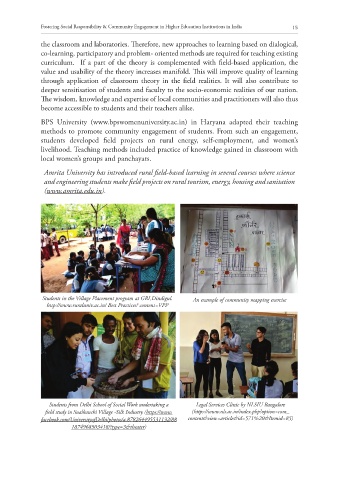
                 Amrita University has introduced rural field-based learning in several courses where science
                 and engineering students make field projects on rural tourism, energy, housing and sanitation
                 (www.amrita.edu.in).


                Students in the Village Placement program at GRI,Dindigul.   An example of community mapping exercise
                 http://www.ruraluniv.ac.in/ Best Practices? content=VPP


                  Students from Delhi School of Social Work undertaking a   Legal Services Clinic by NLSIU Bangalore
                 field study in Sualkauchi Village -Silk Industry (https://www.  (https://www.nls.ac.in/index.php?option=com_
               facebook.com/UniversityofDelhi/photos/a.878264495531132/88  content&view=article&id=571%20&Itemid=85)
                          1874968503418/?type=3&theater)

