


Page 41 - MMTTP_Guidelines_English
P. 41
(iv)  No. of Programmes – Minimum 8 in a year by each implementing Institution

               (v)   Mode of delivery & duration – 9 days (residential)
               (vi)  Modules  –  Host  institutions  will  have  full  autonomy  to  design  curriculum  and
                     pedagogy of the Programme relevance to theme
               (vii)  Assessment  and  certificate  of  participation  –  The  host  institution  shall  assess  the
                     learning outcomes of the participants. Upon successful completion of the Programme,
                     Host Institution shall award a certificate of completion under the aegis of Malaviya
                     Mission  Teacher  Training  Programme  (MMTTP).  Assessment  is  primarily  to  see
                     effectiveness of the delivery and feedback to the participants.
               (viii)  Feedback Mechanism - Participants are required to fill in the feedback form after each
                     Programme.


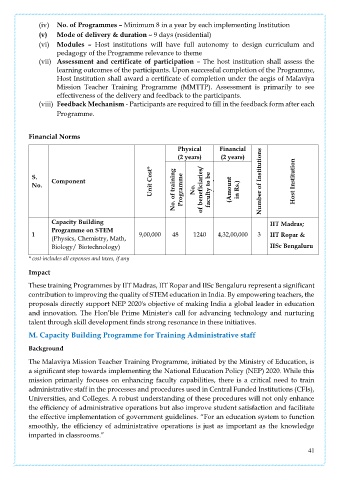
           Financial Norms

                                                               Physical       Financial
                                                               (2 years)       (2 years)
                                                      Unit Cost*                             Number of Institutions   Host Institution
            S.
                   Component
            No.                                               No. of training   Programme   No.   of beneficiaries/   faculty to be   trained   (Amount   in Rs.)


                   Capacity Building                                                            IIT Madras;
                   Programme on STEM
            1                                     9,00,000    48     1240     4,32,00,000   3   IIT Ropar &
                   (Physics, Chemistry, Math,
                   Biology/ Biotechnology)                                                      IISc Bengaluru

           * cost includes all expenses and taxes, if any

           Impact

           These training Programmes by IIT Madras, IIT Ropar and IISc Bengaluru represent a significant
           contribution to improving the quality of STEM education in India. By empowering teachers, the
           proposals directly support NEP 2020's objective of making India a global leader in education
           and innovation. The  Hon’ble Prime  Minister's call for advancing technology and nurturing
           talent through skill development finds strong resonance in these initiatives.
           M. Capacity Building Programme for Training Administrative staff


           Background
           The Malaviya Mission Teacher Training Programme, initiated by the Ministry of Education, is
           a significant step towards implementing the National Education Policy (NEP) 2020. While this
           mission  primarily  focuses  on  enhancing  faculty  capabilities,  there  is  a  critical  need  to  train
           administrative staff in the processes and procedures used in Central Funded Institutions (CFIs),
           Universities, and Colleges. A robust understanding of these procedures will not only enhance
           the efficiency of administrative operations but also improve student satisfaction and facilitate
           the effective implementation of government guidelines. “For an education system to function
           smoothly, the efficiency of administrative operations is just as important  as the knowledge
           imparted in classrooms.”


                                                                                                             41

