


Page 22 - EVALUATION ENGLISH
P. 22
Evaluation Reforms

                   Competencies  describe  how  to  demonstrate  the  ability  to  perform  a  specific  activity  such
                   as  Designing,  Synthesizing,  Evaluating  etc.  However  it  is  important  to  note  that  not  all  the
                   competencies identified may be measurable. Hence, it is necessary to define the Competency,
                   Performance Indicators that may represent a specific and measurable characteristic of a competence.
                   An indicative illustration is provided under appendix 2 at 2.6 which mentions Program Learning
                   Outcome, Competencies and associated Performance Indicators for B.Com. /B.A. (Economics)/B.
                   Sc. (Chemistry) programmes.
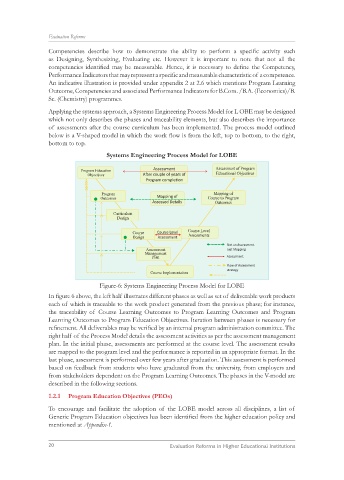
                   Applying the systems approach, a Systems Engineering Process Model for L OBE may be designed
                   which not only describes the phases and traceability elements, but also describes the importance
                   of assessments after the course curriculum has been implemented. The process model outlined
                   below is a V-shaped model in which the work flow is from the left, top to bottom, to the right,
                   bottom to top.
                                        Systems Engineering Process Model for LOBE


                                                                   !


                                     Figure-6: Systems Engineering Process Model for LOBE
                   In figure 6 above, the left half illustrates different phases as well as set of deliverable work products
                   each of which is traceable to the work product generated from the previous phase; for instance,


                   the  traceability  of  Course  Learning  Outcomes  to  Program  Learning  Outcomes  and  Program


                   Learning Outcomes to Program Education Objectives. Iteration between phases is necessary for

                   refinement. All deliverables may be verified by an internal program administration committee. The


                                                                    # !#
                   right half of the Process Model details the assessment activities as per the assessment management

                                                                                              !"
                                                             $           !"
                   plan. In the initial phase, assessments are performed at the course level. The assessment results
                   are mapped to the program level and the performance is reported in an appropriate format. In the

                                                  $
                   last phase, assessment is performed over few years after graduation. This assessment is performed
                   based on feedback from students who have graduated from the university, from employers and
                                                                              &%

                                                                   &%

                   from stakeholders dependent on the Program Learning Outcomes. The phases in the V-model are
                                                 %

                   described in the following sections.                                          +    *       !"
                                                               '  (
                   1.2.1   Program Education Objectives (PEOs)
                                                           )
                                                                                                    %
                   To  encourage  and  facilitate  the  adoption  of  the  LOBE  model  across  all  disciplines,  a  list  of
                                                                                        '
                                                                   * !
                   Generic Program Education objectives has been identified from the higher education policy and
                   mentioned at Appendix-1.
                   20                                          Evaluation Reforms in Higher Educational Institutions

