


Page 21 - EVALUATION ENGLISH
P. 21
Evaluation Reforms

                   problems and challenges faced by society at global or local levels. A review of the goals and
                   outcomes on a regular basis forms an essential step.

                   The  Learning  Performance  Pyramid  describes  an  iterative  model  where  the  organizational
                   characteristics (goals) drive the organizational objectives and objectives further lead to organizational
                   outcomes.
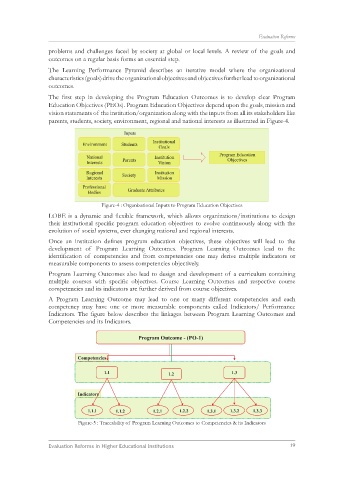
                   The  first  step  in  developing  the  Program  Education  Outcomes  is  to  develop  clear  Program
                   Education Objectives (PEOs). Program Education Objectives depend upon the goals, mission and
                   vision statements of the institution/organization along with the inputs from all its stakeholders like
                   parents, students, society, environment, regional and national interests as illustrated in Figure-4.


                                      Figure-4 : Organizational Inputs to Program Education Objectives
                   LOBE is a dynamic and flexible framework, which allows organizations/institutions to design
                   their institutional specific program education objectives to evolve continuously along with the
                   evolution of social systems, ever changing national and regional interests.
                   Once  an  institution  defines  program  education  objectives,  these  objectives  will  lead  to  the
                   development  of  Program  Learning  Outcomes.  Program  Learning  Outcomes  lead  to  the
                   identification  of  competencies  and  from  competencies  one  may  derive  multiple  indicators  or
                   measurable components to assess competencies objectively.
                   Program Learning Outcomes also lead to design and development of a curriculum containing
                   multiple  courses  with  specific  objectives.  Course  Learning  Outcomes  and  respective  course
                   competencies and its indicators are further derived from course objectives.
                   A  Program  Learning  Outcome  may  lead  to  one  or  many  different  competencies  and  each
                   competency  may  have  one  or  more  measurable  components  called  Indicators/  Performance
                   Indicators. The figure below describes the linkages between Program Learning Outcomes and
                   Competencies and its Indicators.


                              Figure-5 : Traceability of Program Learning Outcomes to Competencies & its Indicators


                   Evaluation Reforms in Higher Educational Institutions                                   19

