


Page 29 - MMTTP_Guidelines_English
P. 29
This is a ‘life-span' approach to promote healthy behaviors among youth. Many of the leading

           causes of disease and disability can be significantly reduced by preventing behaviors that is
           initiated  during  youth,  through  a  broad  spectrum  of  health  education,  understanding  and
           motivation fostered by effective social support and newer policies.

           Almost all adolescents & youth who attend HEIs spend around 7-10 hours every day in the
           learning  environment.  Incorporating  a  strong  wellbeing  domain  into  the  HEIs  can  have
           substantial influence on best practices of holistic health education. Such integration can best be

           achieved by recognizing and addressing the specific unmet psychosocial and learning needs of
           adolescents & youth, by effective and active involvement and collaboration of faculty, students
           and parents etc. Sustainable service models that integrate promotion, early detection and timely
           intervention are the need of today.

           HEIs can therefore facilitate the health of staff, families and community members along with
           the wellbeing of adolescents & youth.

           Keeping  this  in  view,  it  is  realized  that  institutions  need  to  regularly  and  frequently  hold

           workshops and discussions to adopt and disseminate best practices in this matter, and examine
           the systemic gaps in their protocols, so that even a single student does not slip through the gaps.

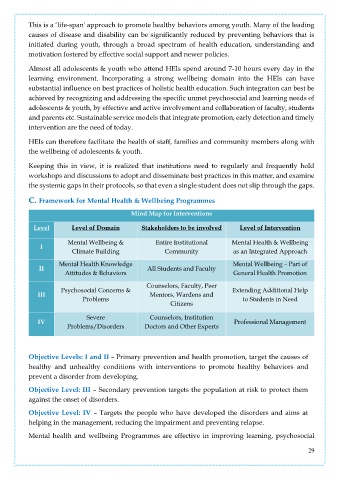
           C. Framework for Mental Health & Wellbeing Programmes

                                               Mind Map for Interventions

             Level        Level of Domain          Stakeholders to be involved       Level of Intervention

                         Mental Wellbeing &             Entire Institutional      Mental Health & Wellbeing
               I
                          Climate Building                 Community               as an Integrated Approach

                      Mental Health Knowledge                                      Mental Wellbeing – Part of
               II                                    All Students and Faculty
                        Attitudes & Behaviors                                      General Health Promotion

                                                    Counselors, Faculty, Peer
                      Psychosocial Concerns &                                      Extending Additional Help
              III                                     Mentors, Wardens and
                              Problems                                                to Students in Need
                                                             Citizens

                               Severe                 Counselors, Institution
              IV                                                                   Professional Management
                         Problems/Disorders         Doctors and Other Experts


           Objective Levels: I and II – Primary prevention and health promotion, target the causes of

           healthy  and  unhealthy  conditions  with  interventions  to  promote  healthy  behaviors  and
           prevent a disorder from developing.
           Objective Level: III – Secondary prevention targets the population at risk to protect them

           against the onset of disorders.

           Objective Level: IV  – Targets the people who have developed the disorders and aims at
           helping in the management, reducing the impairment and preventing relapse.

           Mental health and wellbeing  Programmes are effective in improving learning,  psychosocial

                                                                                                             29

