|
two day National Seminar on
Access and Equity in Higher
Education was organized at
Guru Ghasidas
University Bilaspur on 12th
-13th September, 2003. This
was part of the UGC Golden Jubilee Seminars organized at various
Universities. Prof. J.B.G. Tilak, NIEPA, New Delhi delivered keynote
address and Prof. Grijesh Pant, Vice Chancellor of the University
presided over the function, wherein Dr. N.K. Jain, Additional Secretary,
UGC was the Chief Guest.
Dr. N.K. Jain in his inaugural address described the present scenario
of Indian Higher Education system and its problems such as access,
equity, relevance, quality and resource constraint. He stated that in
India access to Higher Education is 6.7 % of the eligible age group
(16-21 years). The UGC’s objectives are to reach this access
|
ratio atleast double digits during the Tenth Plan
period. He also elaborated the position by comparison between other
countries and India. Dr. Jain informed that the UGC is operating several
schemes for access and equity including the schemes for women and for
disadvantaged groups.
Prof. J.B.G. Tilak, NIEPA, New Delhi, stressed the
need for allocation of more funds for higher education so that access of
education can be extended to cover more and more people to the extent
possible. Prof. Girijesh Pant, Vice Chancellor, in his presidential
address, explained his views regarding higher education
in the State of Chhatisgarh, as it is
a backward and newly born state in India. It needs
more financial assistance to build up infrastructural and education
facilities for the benefit of the people of the region.
|
36 papers were presented in the four technical
sessions of the Seminar. The technical sessions were chaired by Prof.
Arun Kumar, JNU, Prof. J.B.G. Tilak, NIEPA, Prof. Hanumat Yadav,
Barkatullah University, Bhopal, and Prof. Malviya, Department of
Economics, G.G. University, Bilaspur.
The Valedictory Session was chaired by Prof. Girijesh Pant, Vice
Chancellor and the Chief Guest was Prof. Hanumat Yadav. Dr. N.K. Jain,
Additional Secretary, UGC was also present. Prof. Hanumat Yadav stressed
the need of enriching the higher education system in Chhattisgarh. He
further stated that the Government of Chhattisgarh is trying to provide
best educational facilities in the higher education institutions. Dr.
Anjali Gupta, Head Department of Economics, Guru Ghasidas University,
who was the Convenor of the Seminar, presented the reports of the
technical sessions.
|
|
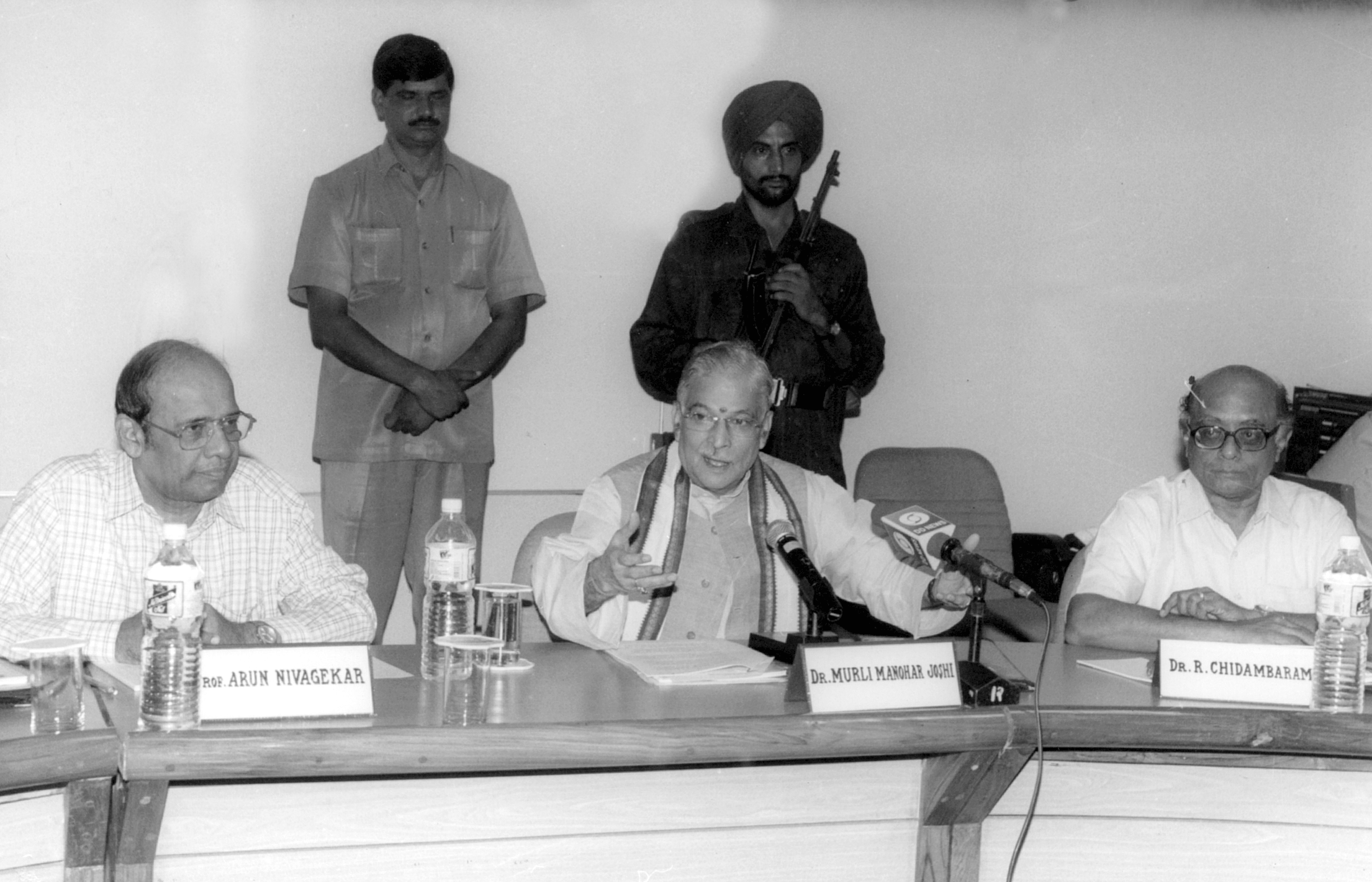
Prof. M.M. Joshi, Dr. R. Chidambaram and Dr. Nigavekar
at the IIT Council meeting
|
period. 30% of the Non-plan funding went towards
research, giving it a much higher weightage. The necessity of taking
more interest in patent filing and commercial utilization of research
findings was also highlighted in the meeting. The student-intake in IITs
has gone up by nearly 10,000 in the last five years. From 14,906 in
1997-98, it has increased to 24,828 in 2002-2003. The substantial
increase has taken place in post graduate education and research.
The issue of setting up campus of IITs abroad was
also discussed in the meeting. The Review Committee, which is looking
into this aspect is expected to submit its report soon. Dr. Joshi told
that most of the developing countries of West and South-East Asia, have
growing demand in science and technology areas. The IITs can provide
leadership for the scientific and technological advancement in these
countries. This would also help in developing linkages with these
countries and promoting India’s economic and commercial interests in
the Asia-Pacific Region.
|
|
esearch
in fundamental
sciences along with advanced training in technological disciplines has to be
strengthened in IITs, said Prof. Murli Manohar Joshi, Minister of HRD,
Science and Technology while chairing a meeting of the Council of the
Indian Institutes of Technology on 7th September. Laying emphasis on
basic research Dr. Joshi said that the fundamental sciences should also
become integral to the technology
|
courses
in IITs. Both the quality and quantity of research in IITs have to be
improved significantly. He emphasised the need for fixing up norms for
such research performance. There has been a near five-fold increase in
grants to IITs during the last five years. From 51.8 crores in 1997-98,
it was enhanced upto Rs. 224.8 crores in 2002-2003. Non-plan funding
also more than doubled from Rs.172.8 crores to Rs.449 crores during the
|