


Page 16 - Guidelines for Training/ Orientation of Faculty on IKS
P. 16
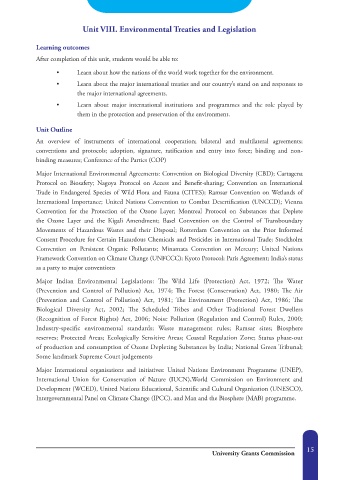
Unit VIII. Environmental Treaties and Legislation


              Learning outcomes
              After completion of this unit, students would be able to:

                     •      Learn about how the nations of the world work together for the environment.

                     •      Learn about the major international treaties and our country’s stand on and responses to
                            the major international agreements.
                     •      Learn  about  major  international  institutions  and  programmes  and  the  role  played  by
                            them in the protection and preservation of the environment.


              Unit Outline
              An  overview  of  instruments  of  international  cooperation;  bilateral  and  multilateral  agreements;
              conventions  and  protocols;  adoption,  signature,  ratification  and  entry  into  force;  binding  and  non-
              binding measures; Conference of the Parties (COP)

              Major International Environmental Agreements: Convention on Biological Diversity (CBD); Cartagena
              Protocol  on  Biosafety;  Nagoya  Protocol  on  Access  and  Benefit-sharing;  Convention  on  International
              Trade in Endangered Species of Wild Flora and Fauna (CITES); Ramsar Convention on Wetlands of
              International Importance; United Nations Convention to Combat Desertification (UNCCD); Vienna
              Convention  for  the  Protection  of  the  Ozone  Layer;  Montreal  Protocol  on  Substances  that  Deplete

              the  Ozone  Layer  and  the  Kigali  Amendment;  Basel  Convention  on  the  Control  of  Transboundary
              Movements  of  Hazardous  Wastes  and  their  Disposal;  Rotterdam  Convention  on  the  Prior  Informed
              Consent Procedure for Certain Hazardous Chemicals and Pesticides in International Trade; Stockholm
              Convention  on  Persistent  Organic  Pollutants;  Minamata  Convention  on  Mercury;  United  Nations
              Framework Convention on Climate Change (UNFCCC); Kyoto Protocol; Paris Agreement; India’s status
              as a party to major conventions

              Major  Indian  Environmental  Legislations:  The  Wild  Life  (Protection)  Act,  1972;  The  Water
              (Prevention  and  Control  of  Pollution)  Act,  1974;  The  Forest  (Conservation)  Act,  1980;  The  Air
              (Prevention  and  Control  of  Pollution)  Act,  1981;  The  Environment  (Protection)  Act,  1986;  The
              Biological  Diversity  Act,  2002;  The  Scheduled  Tribes  and  Other  Traditional  Forest  Dwellers
              (Recognition of Forest Rights) Act, 2006; Noise Pollution (Regulation and Control) Rules, 2000;
              Industry-specific  environmental  standards;  Waste  management  rules;  Ramsar  sites;  Biosphere
              reserves;  Protected  Areas;  Ecologically  Sensitive  Areas;  Coastal  Regulation  Zone;  Status  phase-out
              of production and consumption of Ozone Depleting Substances by India; National Green Tribunal;
              Some landmark Supreme Court judgements

              Major  International  organisations  and  initiatives:  United  Nations  Environment  Programme  (UNEP),
              International  Union  for  Conservation  of  Nature  (IUCN),World  Commission  on  Environment  and
              Development (WCED), United Nations Educational, Scientific and Cultural Organization (UNESCO),
              Intergovernmental Panel on Climate Change (IPCC), and Man and the Biosphere (MAB) programme.


                                                                                                             15
                                                                            University Grants Commission

