


Page 814 - Compendium of UGC Regulations 1957-2023
P. 814
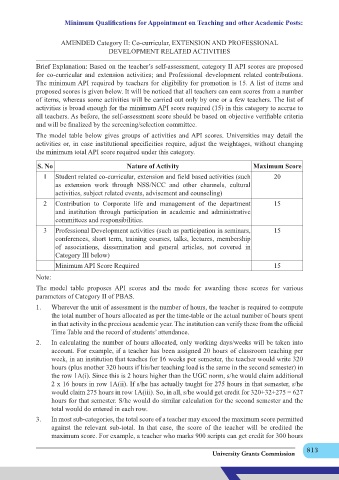
Minimum Qualifications for Appointment on Teaching and other Academic Posts:


                           AMENDED Category II: Co-curricular, EXTENSION AND PROFESSIONAL
                                           DEVELOPMENT RELATED ACTIVITIES

                  Brief Explanation: Based on the teacher’s self-assessment, category II API scores are proposed
                  for  co-curricular  and  extension  activities;  and  Professional  development  related  contributions.
                  The minimum API required by teachers for eligibility for promotion is 15. A list of items and
                  proposed scores is given below. It will be noticed that all teachers can earn scores from a number
                  of items, whereas some activities will be carried out only by one or a few teachers. The list of
                  activities is broad enough for the minimum API score required (15) in this category to accrue to
                  all teachers. As before, the self-assessment score should be based on objective verifiable criteria
                  and will be finalized by the screening/selection committee.
                  The model table below gives groups of activities and API scores. Universities may detail the
                  activities or, in case institutional specificities require, adjust the weightages, without changing
                  the minimum total API score required under this category.

                  S. No                           Nature of Activity                          Maximum Score
                     1   Student related co-curricular, extension and field based activities (such   20
                         as extension work through NSS/NCC  and other channels, cultural
                         activities, subject related events, advisement and counseling)
                     2   Contribution to Corporate life and management  of the department            15
                         and institution  through participation  in academic  and administrative
                         committees and responsibilities.
                     3   Professional Development activities (such as participation in seminars,     15
                         conferences, short term, training courses, talks, lectures, membership
                         of associations, dissemination and general  articles,  not covered in
                         Category III below)
                         Minimum API Score Required                                                  15
                  Note:

                  The  model  table  proposes  API scores and the  mode for awarding  these  scores for various
                  parameters of Category II of PBAS.

                  1.   Wherever the unit of assessment is the number of hours, the teacher is required to compute
                       the total number of hours allocated as per the time-table or the actual number of hours spent
                       in that activity in the precious academic year. The institution can verify these from the official
                       Time Table and the record of students’ attendance.

                  2.   In calculating the number of hours allocated, only working days/weeks will be taken into
                       account. For example, if a teacher has been assigned 20 hours of classroom teaching per
                       week, in an institution that teaches for 16 weeks per semester, the teacher would write 320
                       hours (plus another 320 hours if his/her teaching load is the same in the second semester) in
                       the row 1A(i). Since this is 2 hours higher than the UGC norm, s/he would claim additional
                       2 x 16 hours in row 1A(ii). If s/he has actually taught for 275 hours in that semester, s/he
                       would claim 275 hours in row 1A(iii). So, in all, s/he would get credit for 320+32+275 = 627
                       hours for that semester. S/he would do similar calculation for the second semester and the
                       total would do entered in each row.
                  3.   In most sub-categories, the total score of a teacher may exceed the maximum score permitted
                       against  the relevant  sub-total.  In that  case, the score of the teacher  will be credited  the
                       maximum score. For example, a teacher who marks 900 scripts can get credit for 300 hours

                                                                                                                 813
                                                                                University Grants Commission

