


Page 10 - Guidelines for Training/ Orientation of Faculty on IKS
P. 10
Guidelines for Training/ Orientation of Faculty on IKS
Annexure 1
Model Syllabi for the teacher training guidelines. The following syllabi have been prepared
by the committee to help guide the creation of such courses for teacher training. These
course outlines are not prescriptive and are intended to help the instructors in the
preparation of course syllabi as per the needs of the learners.
Annexure 1A: Model syllabi for IKS modules in the Induction Program
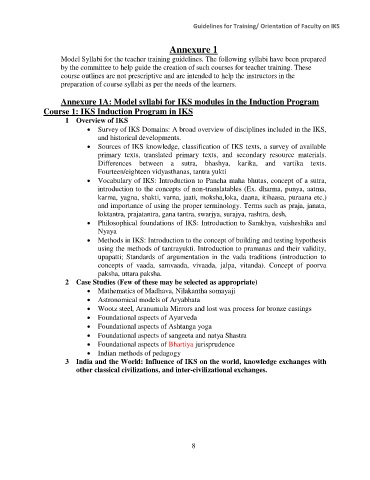
Course 1: IKS Induction Program in IKS
1 Overview of IKS
Survey of IKS Domains: A broad overview of disciplines included in the IKS,
and historical developments.
Sources of IKS knowledge, classification of IKS texts, a survey of available
primary texts, translated primary texts, and secondary resource materials.
Differences between a sutra, bhashya, karika, and vartika texts.
Fourteen/eighteen vidyasthanas, tantra yukti
Vocabulary of IKS: Introduction to Pancha maha bhutas, concept of a sutra,
introduction to the concepts of non-translatables (Ex. dharma, punya, aatma,
karma, yagna, shakti, varna, jaati, moksha,loka, daana, itihaasa, puraana etc.)
and importance of using the proper terminology. Terms such as praja, janata,
loktantra, prajatantra, gana tantra, swarjya, surajya, rashtra, desh,
Philosophical foundations of IKS: Introduction to Samkhya, vaisheshika and
Nyaya
Methods in IKS: Introduction to the concept of building and testing hypothesis
using the methods of tantrayukti. Introduction to pramanas and their validity,
upapatti; Standards of argumentation in the vada traditions (introduction to
concepts of vaada, samvaada, vivaada, jalpa, vitanda). Concept of poorva
paksha, uttara paksha.
2 Case Studies (Few of these may be selected as appropriate)
Mathematics of Madhava, Nilakantha somayaji
Astronomical models of Aryabhata
Wootz steel, Aranumula Mirrors and lost wax process for bronze castings
Foundational aspects of Ayurveda
Foundational aspects of Ashtanga yoga
Foundational aspects of sangeeta and natya Shastra
Foundational aspects of Bhartiya jurisprudence
Indian methods of pedagogy
3 India and the World: Influence of IKS on the world, knowledge exchanges with
other classical civilizations, and inter-civilizational exchanges.
8

