


Page 138 - Academic and Research Book_WEB
P. 138
unusual impact. Therefore, the key determinants in impact are not the number of authors or articles in
              the field but, rather, the mean number of citations per article (density) and the half-life or immediacy
              of citations to a given journal. The time required to review manuscripts may also affect impact. If
              reviewing and publication are delayed, references to articles that are no longer current may not be
              included in the impact calculation. Even the appearance of articles on the same subject in the same
              issue of a journal may have an effect.

              For greater precision, it is preferable to conduct item-by-item journal audits so that any differences
              in impact for these different types of editorial items can be taken into account. For a small number of
              journals a bias may be introduced by including in the numerator these extra citations to items that are
              not part of the denominator of source articles. Clearly, if the denominator is smaller than the actual
              number  of  published  items,  it  will  increase  the  journal’s  impact  factor.  This  in  turn  may  alter  the
              rankings. However, most journals primarily publish substantive research or review articles. Therefore,
              statistical discrepancies are rare. The JCR data (Journal Citation Report data) have come under some
              criticism for this reason among others.
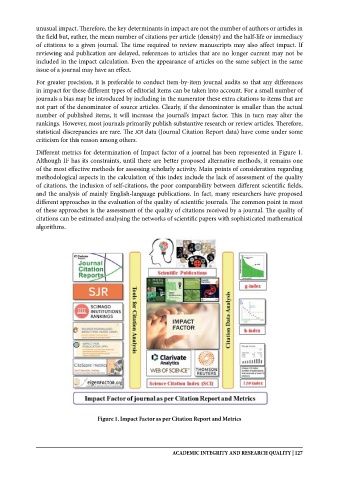
              Different metrics for determination of Impact factor of a journal has been represented in Figure 1.
              Although IF has its constraints, until there are better proposed alternative methods, it remains one
              of the most effective methods for assessing scholarly activity. Main points of consideration regarding
              methodological aspects in the calculation of this index include the lack of assessment of the quality
              of citations, the inclusion of self-citations, the poor comparability between different scientific fields,
              and the analysis of mainly English-language publications. In fact, many researchers have proposed
              different approaches in the evaluation of the quality of scientific journals. The common point in most
              of these approaches is the assessment of the quality of citations received by a journal. The quality of
              citations can be estimated analysing the networks of scientific papers with sophisticated mathematical
              algorithms.


                                   Figure 1. Impact Factor as per Citation Report and Metrics


                                                              ACADEMIC INTEGRITY AND RESEARCH QUALITY | 127

