


Page 13 - Academic and Research Book_WEB
P. 13
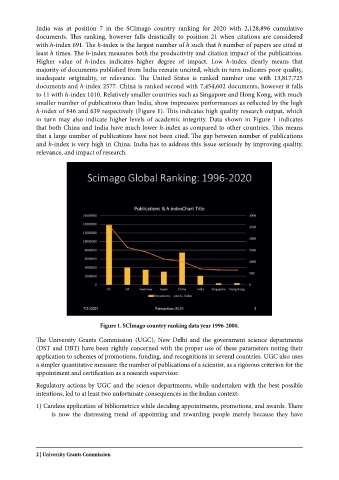
India  was  at  position  7  in  the  SCImago  country  ranking  for  2020  with  2,128,896  cumulative
              documents.  This  ranking,  however  falls  drastically  to  position  21  when  citations  are  considered
              with h-index 691. The h-index is the largest number of h such that h number of papers are cited at
              least h times. The h-index measures both the productivity and citation impact of the publications.
              Higher  value  of  h-index  indicates  higher  degree  of  impact.  Low  h-index  clearly  means  that
              majority of documents published from India remain uncited, which in turn indicates poor quality,
              inadequate  originality,  or  relevance.  The  United  States  is  ranked  number  one  with  13,817,725
              documents and h-index 2577. China is ranked second with 7,454,602 documents, however it falls
              to 11 with h-index 1010. Relatively smaller countries such as Singapore and Hong Kong, with much
              smaller number of publications than India, show impressive performances as reflected by the high
              h-index of 646 and 639 respectively (Figure 1). This indicates high quality research output, which
              in  turn  may  also  indicate  higher  levels  of  academic  integrity.  Data  shown  in  Figure  1  indicates
              that both China and India have much lower h-index as compared to other countries. This means
              that a large number of publications have not been cited. The gap between number of publications
              and h-index is very high in China. India has to address this issue seriously by improving quality,
              relevance, and impact of research.


                                    Figure 1. SCImago country ranking data year 1996-2000.

              The  University  Grants  Commission  (UGC),  New  Delhi  and  the  government  science  departments
              (DST and DBT) have been rightly concerned with the proper use of these parameters noting their
              application to schemes of promotions, funding, and recognitions in several countries. UGC also uses
              a simpler quantitative measure: the number of publications of a scientist, as a rigorous criterion for the
              appointment and certification as a research supervisor.

              Regulatory actions by UGC and the science departments, while undertaken with the best possible
              intentions, led to at least two unfortunate consequences in the Indian context:

              1) Careless application of bibliometrics while deciding appointments, promotions, and awards. There
                   is  now  the  distressing  trend  of  appointing  and  rewarding  people  merely  because  they  have


              2 | University Grants Commission

