


Page 126 - Academic and Research Book_WEB
P. 126
have an advantage because an article published earlier in the year has a better chance of being cited
              than one published later in the year. Many publications that publish infrequently or late in the year
              have  low  Immediacy  Indexes.  For  comparing  journals  specializing  in  cutting  edge  emerging  areas
              of research, the Immediacy Index can provide a useful perspective, however, as peaking of citations
              usually takes several years, the Immediacy Index may not predict ultimate citation performance. It
              would be important to mention that it has a serious flaw, for example, for items published towards the
              end of the year, it would be nearly impossible for them to earn any citations before the year is out.

              The Five-year Impact Factor is more useful for subject areas where it takes longer for work to be cited,
              or where research has more longevity. It offers more stability for smaller titles as there are a larger
              number of articles and citations included in the calculation. However, it still suffers from many of the
              same issues as the traditional Impact Factor.


              Impact Per Publication (IPP)


              Based on the Scopus database, IPP was introduced on the lines of JIF in 2014, and is calculated by
              Leiden University’s Centre for Science and Technology Studies (CWTS). It is defined as the number
              of citations given in a specific year to publications in the past three years divided by the total number
              of peer-reviewed publications (papers, reviews) in the preceding three years. For example, if one is
              considering the IPP for the year 2019, then the publications would be from 2016 to 2018. Like the
              JIF, IPP does not correct for differences in citation practices between different disciplines. Previously
              known as Raw Impact per Publication (RIP), it has been replaced by CiteScore Index in 2016.


              CiteScore

              CiteScore, released by Scopus in December 2016 and calculated by CWTS, replaces the IPP metric
              that  used  to  be  available  in  Elsevier’s  Scopus  database.  CiteScore  is  quite  similar  to  IPP,  however
              its novelty is in the source items considered for its calculation. Apart from considering conference
              proceedings,  along  with  journals  being  its  source  items,  it  includes  letters,  editorials,  corrections,
              and news items, besides articles and review articles, for the calculation of citations. Since CiteScore
              includes larger number of sources and document types, therefore, it seems to have advantage of being
              more representative compared to IPP. It is currently available for journals and book series, which are
              indexed  in  Scopus.  In  addition  to  CiteScore,  Scopus  also  publish  additional  rankings,  such  as  the
              CiteScore percentile based on subject categories, and a monthly CiteScore tracker, for details one can
              visit  JournalMetric.com.

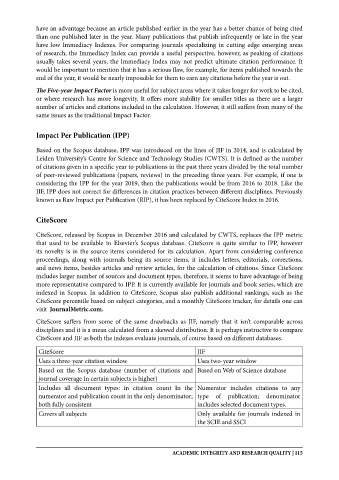
              CiteScore  suffers  from  some  of  the  same  drawbacks  as  JIF,  namely  that  it  isn’t  comparable  across
              disciplines and it is a mean calculated from a skewed distribution. It is perhaps instructive to compare
              CiteScore and JIF as both the indexes evaluate journals, of course based on different databases.

               CiteScore                                              JIF
               Uses a three-year citation window                      Uses two-year window
               Based  on  the  Scopus  database  (number  of  citations  and  Based on Web of Science database
               journal coverage In certain subjects is higher)
               Includes  all  document  types:  in  citation  count  In  the  Numerator  includes  citations  to  any
               numerator and publication count in the only denominator;  type  of  publication;  denominator
               both fully consistent                                  includes selected document types.
               Covers all subjects                                    Only available for journals indexed in
                                                                      the SCIE and SSCI


                                                              ACADEMIC INTEGRITY AND RESEARCH QUALITY | 115

