3.9.   The admission procedure and fixation of fees shall be in accordance with the norms/guidelines prescribed by the UGC and other concerned statutory bodies.
4. Inspection
The UGC may cause periodic inspection of the private university and its off-campus centre(s), study centre(s), off-shore campus(es) etc., offering its programmes.
For this purpose, the UGC may call for all relevant information from the concerned private university, as provided in the UGC (Returns of Information by Universities) Rules, 1979 as 

amended from time to time.
5. Consequences of violations
5.1.   After inspection and assessment of a private university providing first degree and / or post graduate degree/diploma courses, the UGC may indicate to the university any deficiency and non-conformity with the relevant UGC Regulations and give it reasonable opportunity to rectify the same. If the Commission is satisfied that the private university has, even after getting an opportunity to do so, failed to comply with the provisions of any of the Regulations, the Commission may pass an order prohibiting the private university

from offering any course for the award of the first degree and /or the post-graduate degree/ diploma, as the case may be, till the deficiency is rectified. 
5.2.   The UGC may take necessary action against a private university awarding a first degree and / or a post-graduate degree/diploma, which are not specified by the UGC, and inform the public in general through a public notification. A private university continuing such programme(s) 
and awarding unspecified degree(s) shall be liable for penalty under Section 24 of the UGC Act.


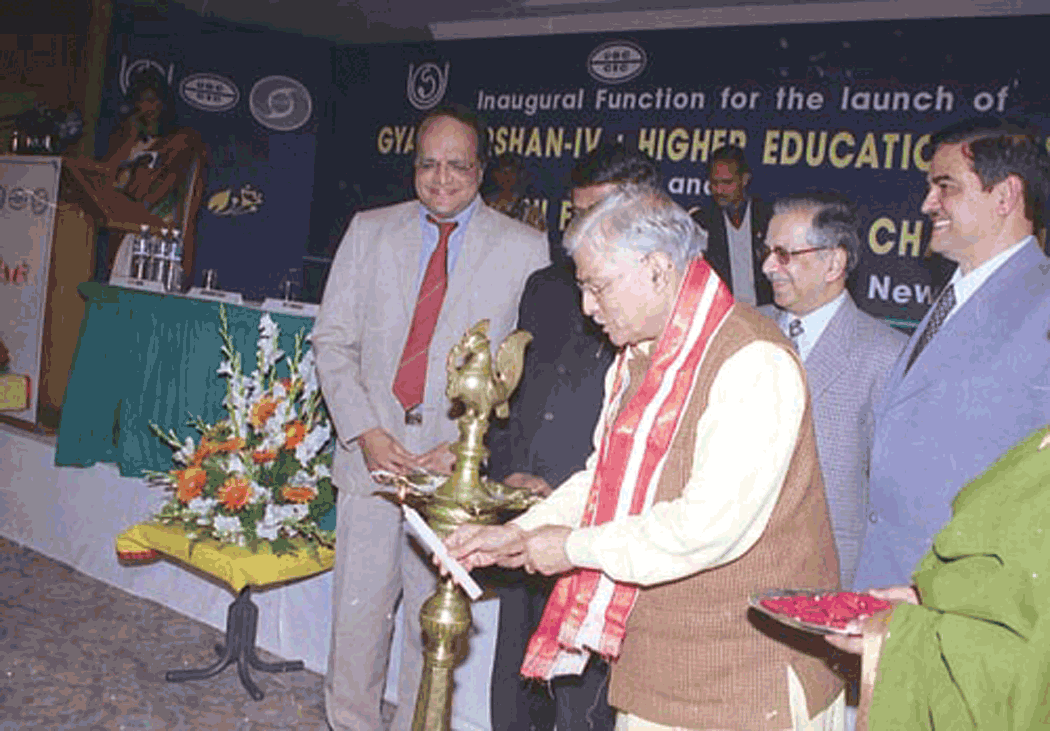
HRM Launches 24-hour Higher Education Channels


             r. Murli   Manohar    Joshi,
             Minister        for     Human
Resource Development and Science & Technology, launched the Higher Education TV Channel 'Vyas" and FM Gyan Vani Channels, on 26th January, 2004, at four metros, viz., Delhi, Mumbai, Chennai and Kolkata. Dr. Joshi, on this occasion, stated that the recent initiatives taken to universalize elementary education in the country would lead to huge 

                   demand      for   higher 
                   education in the   years 
                   to   come,      requiring
                  enormous investment in 
                   infrastructure         and
                   manpower.   The   gap
                   between the   available
                   infrastructure and such
                   great    demand      for
                  quality   education  can
                  only be met with  rapid
                  expansion    of   distant
                  education.    For    this,
open         universities             need
 to make the best use of modern technologies and upgrade their curricula regularly. Open education institutions would also have to see that their degrees and certificates match the best available from the regular stream. He also informed that EDUSAT, the educational satellite would be complete by the year-end and 

would cater to all educational broadcast and telecast needs.
Shri Ravi Shankar Prasad, Minister of State for Information and Broadcasting, emphasized the need for private participation in educational telecast/broadcast.
An initiative of the UGC, Consortium for Educational Communication (CEC), IGNOU and Ministries of Human Resource Development and Information & Broadcasting, the channel will have 85 percent curriculum based programmes and rest as enrichment programmes. It is the fourth in the bouquet of Gyan Darshan Channels, the others being GD-I, GD-II and Eklavya technology channel. 
Shri S.K. Tripathi, Secretary, Higher Education, Ministry of Human Resource Development; Shri Pawan Chopra, Secretary, Ministry of Information & Broadcasting; Prof. V.N. Rajasekharan Pillai, Vice Chairman, University Grants Commission and Prof. H.P. Dikshit, Vice Chancellor, IGNOU also spoke on this occasion.

 
      18       UGC News,  January,   2004
BACK    |    NEXT


D