


Page 5 - Guidelines for Training/ Orientation of Faculty on IKS
P. 5
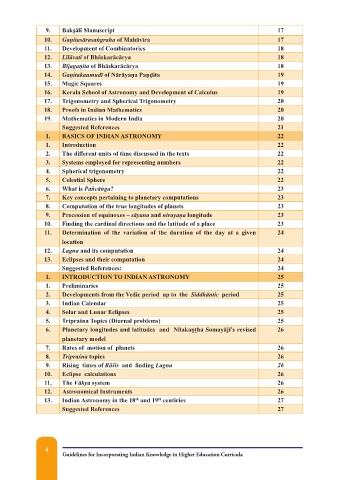
9.    Bakṣālī Manuscript                                                         17
                 10.   Gaṇitasārasaṅgraha of Mahāvīra                                             17
                 11.   Development of Combinatorics                                               18
                 12.   Līlāvatī of Bhāskarācārya                                                  18
                 13.   Bījagaṇita of Bhāskarācārya                                                18
                 14.   Gaṇitakaumudī of Nārāyaṇa Paṇḍita                                          19
                 15.   Magic Squares                                                              19
                 16.   Kerala School of Astronomy and Development of Calculus                     19
                 17.   Trigonometry and Spherical Trigonometry                                    20
                 18.   Proofs in Indian Mathematics                                               20
                 19.   Mathematics in Modern India                                                20
                       Suggested References                                                       21
                 1.    BASICS OF INDIAN ASTRONOMY                                                 22
                 1.    Introduction                                                               22
                 2.    The different units of time discussed in the texts                         22
                 3.    Systems employed for representing numbers                                  22
                 4.    Spherical trigonometry                                                     22
                 5.    Celestial Sphere                                                           22
                 6.    What is Pañcāṅga?                                                          23
                 7.    Key concepts pertaining to planetary computations                          23
                 8.    Computation of the true longitudes of planets                              23
                 9.    Precession of equinoxes – sāyana and nirayaṇa longitude                    23
                 10.   Finding the cardinal directions and the latitude of a place                23
                 11.   Determination  of  the  variation  of  the  duration  of  the  day  at  a  given   24
                       location
                 12.   Lagna and its computation                                                  24
                 13.   Eclipses and their computation                                             24
                       Suggested References:                                                      24
                 I.    INTRODUCTION TO INDIAN ASTRONOMY                                           25
                 1.    Preliminaries                                                              25
                 2.    Developments from the Vedic period  up to  the  Siddhāntic  period         25
                 3.    Indian Calendar                                                            25
                 4.    Solar and Lunar Eclipses                                                   25
                 5.    Tripraśna Topics (Diurnal problems)                                        25
                 6.    Planetary longitudes and latitudes  and  Nīlakaṇṭha Somayājī’s revised     26
                       planetary model
                 7.    Rates of  motion of  planets                                               26
                 8.    Tripraśna topics                                                           26
                 9.    Rising  times of Rāśis  and  finding Lagna                                 26
                 10.   Eclipse  calculations                                                      26
                 11.   The Vākya system                                                           26
                 12.   Astronomical Instruments                                                   26
                 13.   Indian Astronomy in the 18  and 19  centiries                              27
                                                 th
                                                         th
                       Suggested References                                                       27


                 4
                       Guidelines for Incorporating Indian Knowledge in Higher Education Curricula

