


Page 23 - Guidelines for Training/ Orientation of Faculty on IKS
P. 23
Guidelines for Training/ Orientation of Faculty on IKS
Upapattis or proofs in Indian mathematical tradition. Early European scholars of Indian
Mathematics were aware of upapattis. Some important commentaries which present
upapattis. Bhāskarācārya II on the nature and purpose of upapatti. Upapatti of bhujā-
koṭi-karṇa-nyāya (Baudhayana-Pythagoras theorem). Upapatti of kuṭṭaka process.
Restricted use of tarka (proof by contradiction) in Indian Mathematics. The Contents of
Gaṇita-yukti-bhāṣā. Yukti-bhāṣā demonstration of bhujā-koṭi-karṇa-nyāya. Estimating
the circumference by successive doubling of circumscribing polygon.
Expression for abādhās, area and circum-radius of a triangle. Theorem on the sum of the
product of chords (jyāsaṃvarga-nyāya). Theorem on the difference of the squares of the
chords (jyāvargāntara-nyāya). From jyāsaṃvarga-nyāya to jyotipatti (generation of
tabular sines). The cyclic quadrilateral. Expression for the diagonals in terms of the sides.
Expression for the area in terms of the diagonals. Expression for the area and circum-
radius in terms of the sides.
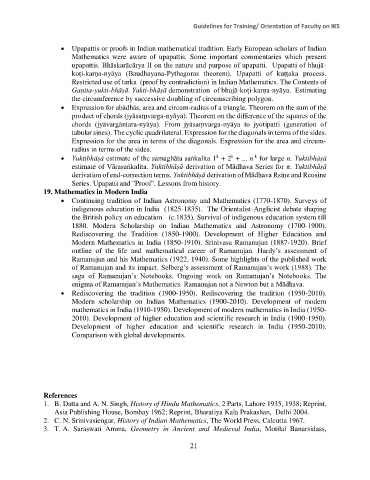
k
k
k
Yuktibhāṣā estimate of the samaghāta saṅkalita 1 + 2 + ... n for large n. Yuktibhāṣā
estimate of Vārasaṅkalita. Yuktibhāṣā derivation of Mādhava Series for π. Yuktibhāṣā
derivation of end-correction terms. Yuktibhāṣā derivation of Mādhava Rsine and Rcosine
Series. Upapatti and "Proof". Lessons from history.
19. Mathematics in Modern India
Continuing tradition of Indian Astronomy and Mathematics (1770-1870). Surveys of
indigenous education in India (1825-1835). The Orientalist-Anglicist debate shaping
the British policy on education (c.1835). Survival of indigenous education system till
1880. Modern Scholarship on Indian Mathematics and Astronomy (1700-1900).
Rediscovering the Tradition (1850-1900). Development of Higher Education and
Modern Mathematics in India (1850-1910). Srinivasa Ramanujan (1887-1920). Brief
outline of the life and mathematical career of Ramanujan. Hardy’s assessment of
Ramanujan and his Mathematics (1922, 1940). Some highlights of the published work
of Ramanujan and its impact. Selberg’s assessment of Ramanujan’s work (1988). The
saga of Ramanujan’s Notebooks. Ongoing work on Ramanujan’s Notebooks. The
enigma of Ramanujan’s Mathematics. Ramanujan not a Newton but a Mādhava.
Rediscovering the tradition (1900-1950). Rediscovering the tradition (1950-2010).
Modern scholarship on Indian Mathematics (1900-2010). Development of modern
mathematics in India (1910-1950). Development of modern mathematics in India (1950-
2010). Development of higher education and scientific research in India (1900-1950).
Development of higher education and scientific research in India (1950-2010).
Comparison with global developments.
References
1. B. Datta and A. N. Singh, History of Hindu Mathematics, 2 Parts, Lahore 1935, 1938; Reprint,
Asia Publishing House, Bombay 1962; Reprint, Bharatiya Kala Prakashan, Delhi 2004.
2. C. N. Srinivasiengar, History of Indian Mathematics, The World Press, Calcutta 1967.
3. T. A. Saraswati Amma, Geometry in Ancient and Medieval India, Motilal Banarsidass,
21

