


Page 25 - Deeksharambh - A Guide to Student Induction 17-7-2019 eng
P. 25
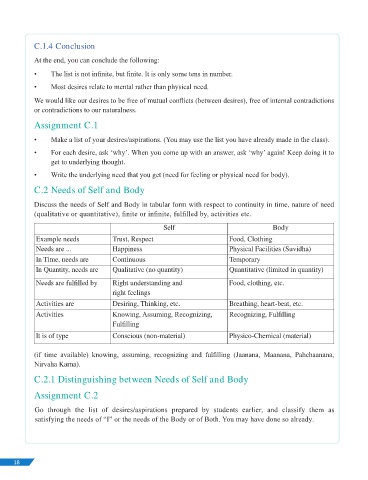
C.1.4 Conclusion

               At the end, you can conclude the following:

               •     The list is not infinite, but finite. It is only some tens in number.

               •     Most desires relate to mental rather than physical need.

               We would like our desires to be free of mutual conflicts (between desires), free of internal contradictions
               or contradictions to our naturalness.

               Assignment C.1


               •     Make a list of your desires/aspirations. (You may use the list you have already made in the class).
               •     For each desire, ask ‘why’. When you come up with an answer, ask ‘why’ again! Keep doing it to
                     get to underlying thought.

               •     Write the underlying need that you get (need for feeling or physical need for body).

               C.2 Needs of Self and Body

               Discuss the needs of Self and Body in tabular form with respect to continuity in time, nature of need
               (qualitative or quantitative), finite or infinite, fulfilled by, activities etc.

                                                          Self                                Body
                Example needs            Trust, Respect                         Food, Clothing
                Needs are ...            Happiness                              Physical Facilities (Suvidha)
                In Time, needs are       Continuous                             Temporary
                In Quantity, needs are   Qualitative (no quantity)              Quantitative (limited in quantity)

                Needs are fulfilled by    Right understanding and                Food, clothing, etc.
                                         right feelings
                Activities are           Desiring, Thinking, etc.               Breathing, heart-beat, etc.

                Activities               Knowing, Assuming, Recognizing,        Recognizing, Fulfilling
                                         Fulfilling
                It is of type            Conscious (non-material)               Physico-Chemical (material)


               (if  time  available)  knowing,  assuming,  recognizing  and  fulfilling  (Jaanana,  Maanana,  Pahchaanana,
               Nirvaha Karna).
               C.2.1   Distinguishing between Needs of Self and Body


               Assignment C.2

                Go  through  the  list  of  desires/aspirations  prepared  by  students  earlier,  and  classify  them  as
                satisfying the needs of “I” or the needs of the Body or of Both. You may have done so already.


                  18
                 18
         18

